

JOIN US FOR A 2026 HEALING ADVENTURE!
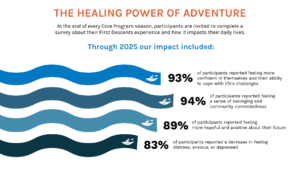
At First Descents, we are committed to rigorously evaluating program impact and continually strengthening the effectiveness of our work. We collect standardized post-program survey data from participants to assess outcomes related to psychosocial well-being, including measures of connection, self-efficacy, and quality of life. These insights directly inform ongoing program refinement and delivery.
This participant-reported data is complemented by formal research. To date, First Descents has participated in a variety of independent impact studies, each individually focused on our oncology, MS, and healthcare professionals programs, contributing to a growing body of evidence supporting adventure-based, peer-supported interventions for young adults with serious health conditions and those working in those healthcare fields.
Our approach aligns with both the National Cancer Institute’s identification of psychosocial supportive care as a critical determinant of long-term survivorship outcomes, and the National Multiple Sclerosis Society‘s recommendations that physical activity can have a positive impact on mood and quality of life for those diagnosed with MS. First Descents delivers this support through immersive, peer-based outdoor experiences designed to foster resilience, social connection, and sustained behavior change.
Cancer, MS, and other serious health conditions present distinct clinical and psychosocial challenges during young adulthood, a developmental stage defined by identity formation, career-building, and relationship development. Cancer remains the leading disease-related cause of death among adolescents and young adults (AYAs), with more than 90,000 new diagnoses annually in the United States, making it the fastest-growing and most underserved demographic in oncology.
Similarly, MS is the most common neuroinflammatory disease affecting young adults and is typically diagnosed between the ages of 20 and 40, further underscoring the need for interventions that address both medical and psychosocial complexity during this life stage.
*Source: seer.cancer.gov, American Cancer Society, National MS Society
Nature-Based Programs & COVID-19 Healthcare Workers: From 2021 to 2023, First Descents collaborated with the NIH to study the impact of our programs for healthcare workers responding to the COVID-19 pandemic. Findings suggest that nature-based programs can be used to improve overall well-being among COVID-19 healthcare workers, and that additionally, integrating audio-based mindfulness practices to these programs may enhance their benefits.
Outdoor Adventure Programs & MS: In 2021, the International Journal of MS Care published a review of outdoor adventure programs that explored the current literature on these types of programs for the general population and medical populations; examined how outdoor adventure programs could enhance mood, functioning, and quality of life for individuals with MS; and suggested future directions for research on outdoor adventure programs tailored to persons with MS.
Healing Through Adventure & MS: First Descents was the subject of a pilot study presented to the Faculty of the California School of Professional Psychology that used archival data from the 2019 First Descents MS programs to analyze changes in self-efficacy, anxiety, depression, quality of life, social support, and mindfulness-based self-efficacy. Participants demonstrated improved self-efficacy, reductions in anxiety, and increases in mindfulness-based self-efficacy following their one-week adventure program. There were no statistically significant changes in depression, quality of life, and social support scores.
Benefits of FD Programming & Cancer: In 2015, First Descents worked with the University of Michigan to evaluate the psychosocial benefits of our programming on young adults diagnosed with cancer. The top findings from this study included an increase in self-esteem, body image and our participants’ ability to cope with cancer and its ongoing effects. Additionally, reports of moderate to severe depression and anxiety (as measured by the PHQ-4) marked a 60% decrease for FD participants.
Psychosocial Effects of FD Programs: The 2015 study continued First Descents’ effort to better understand the psychosocial effects of going on a First Descents program following up on a study conducted in 2012 with the Keck Graduate Institute.